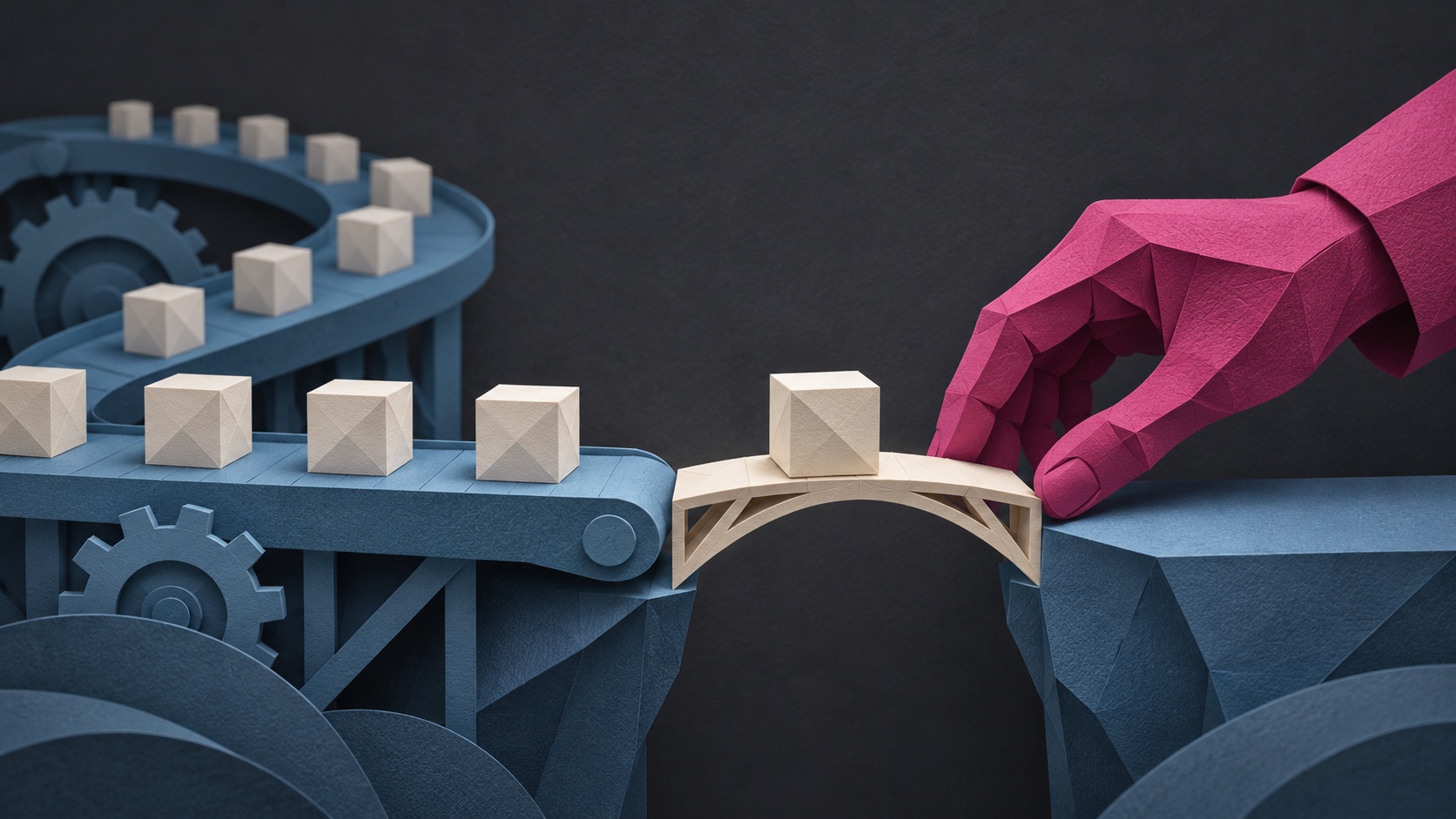
Most companies are looking at AI through the lens of efficiency: reducing costs, generating more content, automating customer service and scaling without hiring more people. These are reasonable questions. But one is missing: where might we destroy trust by automating too much?
Not every point of contact has the same value. There are times when the customer wants speed. At others, they need to know that someone understands what is happening to them and takes responsibility for the solution. They do not need a person for everything. They need someone behind it when it matters.
That is what I mean by The Human Premium: the value of the human element in an increasingly automated experience. Not necessarily a more expensive service. That value may lie in trust, in the customer deciding to stay, or in an experience they are willing to pay more for.
This is not about going backwards
This does not mean returning to an analogue world, romanticising slow processes or having a person answer every interaction just to make the organisation chart feel loved. Operational nostalgia rarely scales.
It means deciding where automation helps and where we need visible human judgement. Because we can build a highly efficient operation and, at the same time, an experience in which nobody knows who takes responsibility when something goes wrong.
Education illustrates this well. AI can help generate content, exercises, feedback and learning pathways. But if more and more institutions can produce all of that, what really differentiates them?
Who designs the learning. Who checks its rigour. Who supports the student, certifies what they have learnt and takes responsibility for quality. And what community the student finds along the way.
Content still matters. But having more content does not, in itself, answer any of those questions.
The same question comes up in other businesses
In recruitment, a candidate can use AI to prepare an immaculate CV, a brilliant cover letter and a beautifully presented portfolio. That means looking beyond the output: what they understand, what judgement they have and how they make decisions when there is no template to follow.
In sales and marketing, we can produce thousands of personalised messages. The question is whether anyone is really listening. When everyone can personalise, personalisation can also become well-dressed noise.
The common thread is interesting: producing something convincing and taking responsibility for it are two different things. An institution can generate a recommendation that appears very precise. What matters is what happens if that recommendation does not fit the person's actual situation.
AI-assisted. With someone accountable
AI-assisted, human-accountable. That is the idea. Not hiding AI or pretending a person has done everything. Explaining what is automated, where human judgement comes in and who takes responsibility when it matters.
This needs operational decisions, not another nice phrase about putting the customer at the centre.
Which enquiries can we resolve automatically? Which decisions need reviewing? When should a person step in? Who takes responsibility if the answer is wrong? Can the customer reach that person, or are they left going round in circles within the system?
In an educational institution, for example, offering an automated tutor and a separate support service is not enough. We need to decide how they connect, what the person stepping in needs to know and who takes responsibility for the whole experience.
We will be able to offer human mentoring, assessments based on expert judgement or verified communities. We will also be able to use technology to check authorship and make decisions traceable. But no label replaces the work of designing and sustaining that service.
Saying ‘reviewed by a person’ means little if that review lacks the time, judgement or ability to change the outcome.
Where it is worth being present
For years, we have tried to remove human friction in order to scale. Now we may need to bring human presence back much more deliberately. Not everywhere, and not out of romanticism. Where it contributes judgement, trust or a relationship worth looking after.
AI will change much more than productivity. For companies, deciding where to retain human judgement, presence and accountability will be part of designing the business.
Because when everything can appear human, being human will no longer be a given. And demonstrating who takes responsibility may matter far more than producing another perfect answer.